





Behind the Meter: The Fastest Path to Power for the AI Factory

Every developer at this point can recite the queue numbers from memory. The backlog, which peaked near 2,600 GW at the end of 2023, sits at roughly 2,061 GW after a wave of 2025 withdrawals. The median project still takes the better part of five years to clear it (Lawrence Berkeley National Laboratory, 2025). During this time, more than just the diagnosis has changed. A meaningful share of the industry has responded by not treating the queue as a problem to solve. They’re, instead, viewing it as a constraint to route around. And this routing mechanism is behind-the-meter generation, built, owned, and dispatched by the load itself.
Behind-the-Meter Deal Flow: Bloom Energy, Prometheus Hyperscale, IEP
The hedge has disappeared. It's a primary development strategy, with reflection in the deal flow. Bloom Energy secured a commitment from Brookfield to invest up to $5 billion in its on-site solid-oxide fuel cell systems (Latitude Media, 2025). Prometheus Hyperscale is partnering with Conduit Power on up to 300 MW of behind-the-meter gas generation and battery storage across two Texas sites (Latitude Media, 2025). International Electric Power is permitting a 944 MW gas plant in Pennsylvania built specifically to power a data center. From day one, the plant was designed to avoid PJM interconnection entirely (Latitude Media, 2025). None of these are backup generators sized for an outage. They will function as primary power plants sized for a campus, to be built by companies that concluded a permanent divergence in the grid's timeline and that of their own.
Data Center Capacity is Declining in Core U.S. Markets
The mismatch is quantified. Bloom Energy's March 2026 survey of developers, hyperscalers, colocation operators, utilities, and equipment vendors puts the current time-to-power gap at 1.5 to 2 years. This is longer than what the same respondents expected as recently as 2023 (Data Center Knowledge, 2026). CBRE's own market tracking shows total under-construction capacity actually declining in Northern Virginia and Dallas-Fort Worth. The regions constitute two of the country's most established hubs, with power procurement cited as a primary cause (CBRE, via Data Center Knowledge, 2026). This points to something more than just queue friction at the margins. In facilities that would otherwise be under active construction today, it means core markets are losing capacity because the power isn't there.
Transformer Lead Times vs. Behind-the-Meter Build Speed
The equipment math explains why on-site generation wins that trade even before you get to interconnection. Large power transformer lead times have stretched to roughly 128 weeks on average, with generator step-up units running 144 weeks or more. That can be effectively three to five years depending on the unit (Financial Times, via AI Weekly, 2026; IndustrialSage, 2026). A behind-the-meter build, by contrast, can be permitted, procured, and energized in something closer to 16 to 30 months depending on the generation technology chosen (Avanza Energy, 2026). When the alternative to waiting on the grid is waiting on a transformer that's backordered into the 2030s, the on-site plant is the faster option.
Comparing On-Site Generation Technologies for Hyperscale Load
It is also, increasingly, the technically superior one for the specific load profile a hyperscale campus presents. Fuel cells run at 60–65% fuel-to-electricity efficiency and can be stacked to roughly 100 MW per acre. This matters on space-constrained urban and suburban sites where a conventional plant footprint isn't available (Avanza Energy, 2026). Reciprocating engines deliver closer to 50 MW per acre; aeroderivative turbines in multi-unit configuration reach 72–86 MW per acre (Avanza Energy, 2026). None of these numbers matter in isolation. But when a developer zooms out, they now have a genuine menu of on-site technologies.

Turbine rotor blades before final assembly.
They can weigh options that match site constraints, fuel availability, and emissions posture, overriding a single default choice. Renewables plus storage remain, for now, the wrong tool for this specific job: continuous, 24/7, high-density baseload load doesn't fit a resource that's inherently variable. Pairing it with enough storage to fake baseload is still cost-prohibitive at the scale these campuses require (Enverus, 2026). Gas (turbine or reciprocating) is filling that gap as the only dispatchable, deployable-on-a-two-year-timeline option that clears the bar.
The Next Supply Chain Risk: Gas Turbines
But behind-the-meter is not a clean escape from supply chain risk. A different piece of equipment is now exposed. GE Vernova's gas turbine order backlog has swelled to 116 GW, pushing new deliveries out to 2031 (Enverus, 2026), even as the company targets 20 GW of annualized turbine output in 2026 and beyond (Build, 2026). A developer who exits the interconnection queue to avoid a four-year transformer wait can walk directly into a five-year turbine wait if they're not early in that line too. The market has correctly identified that grid interconnection is the binding constraint on power delivery. It has yet to fully absorb that behind-the-meter generation simply substitutes one equipment queue for another. It is a better one, on current numbers, but not an infinite one, and not one that scales indefinitely as every hyperscaler reaches the same conclusion simultaneously.
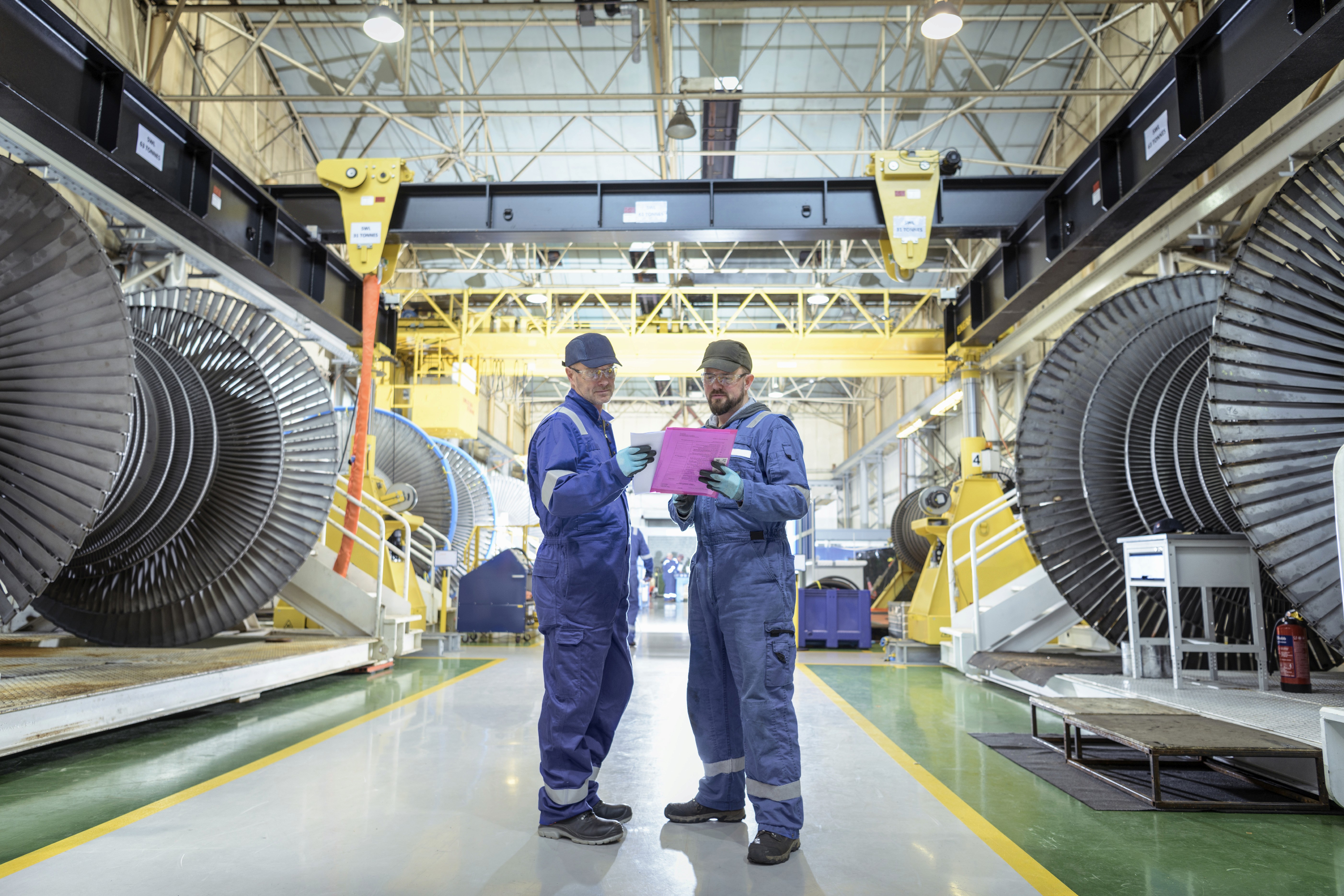
Completed turbine units await their next stage.
Colocation Capacity, Pre-leasing, and the Load Growth Curve
The market backdrop makes clear how quickly this has become mainstream rather than fringe. JLL tracks roughly 8 GW of colocation capacity currently under construction in the U.S. 73% of it is pre-leased: a level of forward commitment that only makes sense if the tenants signing those leases have reasonable confidence in power delivery. This increasingly means on-site generation is baked into the deal, and not bolted on after a permitting setback (JLL, via Latitude Media, 2025). Berkeley Lab's own load projections (U.S. data center electricity consumption rising from 176 TWh in 2023 to somewhere between 325 and 580 TWh by 2028) make it structurally obvious why (Lawrence Berkeley National Laboratory, via Build, 2026). JLL separately projects close to 100 GW of new data center capacity globally between 2026 and 2030 (JLL, via Build, 2026). No transmission build-out plan on the table today absorbs that curve on the timeline the load is arriving. The industry makes one thing glaringly clear with behind-the-meter. The interconnection crisis isn't getting solved on the timeline that matters, and parties need to build accordingly.
Permitting Risk: What Dublin Signals for U.S. Regulators
The permitting risk on these plants is now more specific and arrives earlier. Gas turbine installations for data center use face the same air-quality permitting requirements as any other combustion source. That review runs on its own clock, independent of equipment delivery (Green Gas Turbines, 2026). Dublin offers a preview of where this goes once regulators catch up. Three data centers there were recently granted permitted load under tighter rules that explicitly require on-site generation or battery capacity as a condition of approval (An Coimisiún Pleanála, via Archdesk, 2026). That's the opposite of today's U.S. dynamic, where behind-the-meter generation is mostly a developer's choice to route around the grid. Once a regulator makes it a permitting condition instead, the calculus for every project in that jurisdiction changes. It's a reasonable bet that more grid operators, watching load growth outpace their own build-out plans, will eventually make the same move as PJM avoidance is currently voluntary.
Owning vs. Contracting: How These Power Deals get Financed
Ownership structure is the other variable worth separating out, because "behind-the-meter" describes the interconnection point, and not who holds the asset. Some of this generation sits on a hyperscaler's own balance sheet. But a meaningful share of it doesn't. That’s being built and operated by independent power producers and equipment vendors who then sell the output back to the campus under a long-term power agreement. This is closer to how a conventional IPP relationship works than how a corporate PPA for renewables typically works. That distinction matters for how these deals actually get financed and who holds the fuel-price and equipment-delivery risk. A developer evaluating a site today is weighing gas over grid. But they also face the choice of whether to own the plant, contract for its output, or do some combination of both. This is an important decision that will determine whether the project clears financing at all.
TerraPower, Meta, and the 2030s Nuclear Alternative
The next horizon past gas is already visible, if not yet at real capacity. TerraPower and a handful of advanced nuclear developers have signed non-binding letters of intent covering close to 18 GW of future behind-the-meter demand. Meta's own commitment sits inside that figure: two Natrium reactors funded outright, delivering 690 MW starting around 2032, plus rights (not yet firm orders) to six more units that could add another 2.1 GW by 2035 (TerraPower, 2026). That reflects a 2030s solution, arriving years after the gap it's meant to close. This is precisely why gas (with its two-year deployment window and its own tightening backlog) occupies the position it does.
REFERENCES
[1] Rand, J. et al. (Lawrence Berkeley National Laboratory). "Queued Up: Characteristics of Power Plants Seeking Transmission Interconnection." LBNL Energy Markets & Planning, 2025 update, July 2026. https://emp.lbl.gov/queues
[2] Jenkins, Lisa Martine. "Behind-the-Meter Generation Is Picking Up Traction." Latitude Media, incl. JLL data, October 24, 2025. https://www.latitudemedia.com/news/behind-the-meter-generation-is-picking-up-traction/
[3] Data Center Knowledge. "Why Data Centers Are Turning to Behind-the-Meter Power." Data Center Knowledge, incl. CBRE data, June 9, 2026. https://www.datacenterknowledge.com/energy-power-supply/why-data-centers-produce-their-own-power
[4] AI Weekly (summarizing Financial Times reporting). "AI Data Center Boom Blows Out Power Transformer Lead Times From Months to 4-5 Years — Half of 2026 US Capacity at Risk of Delay." AI Weekly, July 2026. https://aiweekly.co/node/5928
[5] IndustrialSage. "Power Transformer Lead Times Hit 128 Weeks in 2026." IndustrialSage, May 2026. https://www.industrialsage.com/power-transformer-lead-times-us-grid-shortage/
[6] Avanza Energy. "The $350 Million Shortcut: Why Data Centers Are Ditching the Grid Instead of Waiting 7 Years for Power." Avanza Energy, February 3, 2026. https://avanzaenergy.substack.com/p/data-centers-are-killing-the-grid
[7] Enverus. "Natural Gas Behind-the-Meter Power for Data Centers." Enverus Blog, June 26, 2026. https://www.enverus.com/blog/why-data-centers-are-looking-to-natural-gas-for-behind-the-meter-power/
[8] Build. "Behind-the-Meter Power for Data Centers: Why Gas Turbines Are Back in the Stack." Build Insights, incl. JLL data and Lawrence Berkeley National Laboratory data on data center load growth, May 6, 2026. https://build.inc/insights/behind-the-meter-power-data-centers
[9] TerraPower. "TerraPower and Meta Enter Agreement for 8 Natrium® Advanced Nuclear Plants." TerraPower, January 9, 2026. https://www.terrapower.com/terrapower-announces-deal-with-meta
[10] Green Gas Turbines. "Gas Turbines for Data Centers 2026: Behind-the-Meter Power for AI & Hyperscale Facilities." Green Gas Turbines Blog, April 1, 2026. https://www.greengasturbines.com/blog/gas-turbines-for-data-centers-hyperscaler-power
[11] An Coimisiún Pleanála (reported by Data Center Knowledge, January 2026), cited in Archdesk. "AI Data Center Construction 2026: Capex, Cost per MW, Delays." Archdesk Blog, 2026. https://archdesk.com/blog/global-ai-data-center-construction-2026